Back
Module01
Title

Thermal resistance

Synthetic Course: written to test the Site template, from no Professor's material

Watch

Explainer video0:04
Deep Dive audio0:04

Summary

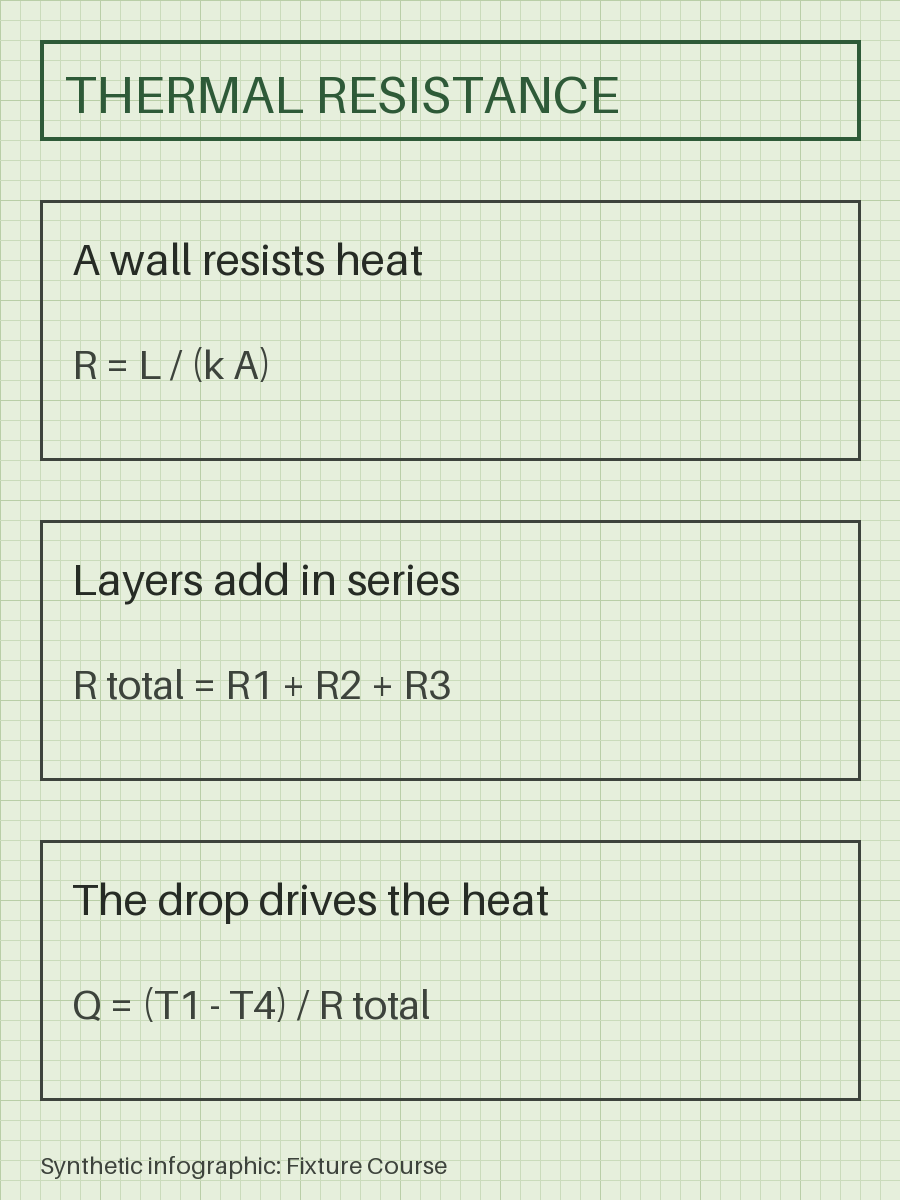
Thermal resistance on one page: a wall resists heat, R = L/(kA); layers add in series; the temperature drop drives the heat through the total resistance.
InfographicTap to zoom
Infographic
Thermal resistance on one page: a wall resists heat, R = L/(kA); layers add in series; the temperature drop drives the heat through the total resistance.

A wall resists heat like a resistor resists current

In steady conduction through a plane wall, the heat rate is set by the temperature drop across the wall and by the wall’s thermal resistance:

Q˙=ΔTR,R=LkA\dot{Q} = \frac{\Delta T}{R}, \qquad R = \frac{L}{k A}

A thicker wall (larger LL) resists more; a better conductor (larger kk) or a larger face (larger AA) resists less. Layers in series add their resistances, Rtotal=∑RiR_\text{total} = \sum R_i, and the same Q˙\dot{Q} passes through every layer.

الجدار يقاوم سريان الحرارة كما يقاوم المقاوم سريان التيار: فرق درجات الحرارة يدفعها، والمقاومة R=LkAR = \frac{L}{kA} تحدّ منها. في الشكل جدار سمكه 0.2 م تهبط حرارته من 20 إلى 5 درجات في خط مستقيم.
Assumed
supplied here, not in the Materials: x=0x = 0 · L=0.2 mL = 0.2\ \text{m} · T1=20T_1 = 20 · T2=5 ∘CT_2 = 5\ ^\circ\text{C}
−0.100.000.100.200510152025TT (°C)xx (m)T1T_1T2T_2
Fig.An illustrative wall 0.2 m0.2\ \text{m} thick; the temperature falls in a straight line

Worked examples

TopicThermal resistance
Title

Heat loss through a composite wall

ExampleW01.1
Step1 / 6
Mode
Given
Given

A wall is plaster, brick and insulation in series. Its inside face is held at T1T_1 and its outside face at T4T_4. Find the heat loss Q˙\dot{Q} through the wall.

  • A=1 m2A = 1\ \text{m}^2
  • T1=20 ∘CT_1 = 20\ ^\circ\text{C} (inside face)
  • T4=−5 ∘CT_4 = -5\ ^\circ\text{C} (outside face)
Layer resistances, R=LkAR = \frac{L}{kA}
LayerLLmkkW/(m·K)RRK/WΔT\Delta TK
Plaster0.020.5
Brick0.200.8
Insulation0.050.04
Total
−0.100.000.100.200.30−10−50510152025TT (°C)xx (m)T1T_1T4T_4
Fig.The wall: plaster to 0.02 m0.02\ \text{m}, brick to 0.22 m0.22\ \text{m}, insulation to 0.27 m0.27\ \text{m}

Read the wall

Three layers in series between two faces at known temperatures. The table gives each layer's LL and kk; the RR and ΔT\Delta T columns are ours to fill.
ثلاث طبقات على التوالي بين وجهين حرارتهما معلومة: الداخلي عند 20 درجة والخارجي عند −5 درجات. نحسب مقاومة كل طبقة ثم نجمع المقاومات.
TopicThermal resistance
Title

A plate cooling from both faces

ExampleW01.2
Step1 / 5
Mode
Given
Given

A plate 40 mm40\ \text{mm} thick is at 200 ∘C200\ ^\circ\text{C} throughout when both its faces are suddenly held at 20 ∘C20\ ^\circ\text{C}. Its diffusivity is α=12 mm2/s\alpha = 12\ \text{mm}^2/\text{s}. Find the temperatures across it after t=30 st = 30\ \text{s}.

  • L=40 mmL = 40\ \text{mm}
  • Ti=200 ∘CT_i = 200\ ^\circ\text{C}
  • Ts=20 ∘CT_s = 20\ ^\circ\text{C} on both faces
  • α=12 mm2/s\alpha = 12\ \text{mm}^2/\text{s}
  • t=30 st = 30\ \text{s}
The plate at t=30 st = 30\ \text{s}, face to face
xxmmTT∘C^\circ\text{C}
0
10
20
30
40

Read the problem

The plate cools from both faces alike, so it stays symmetric about its mid-plane, x=20 mmx = 20\ \text{mm}. Work in θ=T−TsTi−Ts\theta = \frac{T - T_s}{T_i - T_s}, which falls from 11 towards 00.
Sim

The plate cooling from both faces

Move tt to watch the plate cool, or α\alpha to make it another material. The table reads it where W01.2 does; the map shows the whole plate over time.

Assumed
supplied here, not in the Materials: tt tuned from 00 to 120 s120\ \text{s} in steps of 11 · α\alpha tuned from 44 to 40 mm2/s40\ \text{mm}^2/\text{s} in steps of 11
TT (°C)
xx (mm)
Fig.The temperature across the wall at the chosen time, between where it starts and where it settles, both dashed.
xx (mm)TT (°C)
020.0
1037.6
2044.9
3037.6
4020.0

Fo=αtL2\mathrm{Fo} = \frac{\alpha t}{L^2} = 0.225: the mid-plane is at 44.9 °C, the quarter points at 37.6 °C

Practice

1. A furnace burns methane, CHX4+2 OX2→COX2+2 HX2O\ce{CH4 + 2O2 -> CO2 + 2H2O}, and holds the inside face of its fireclay wall at 600 K600\ \text{K} above the outside face. The wall is L=0.25 mL = 0.25\ \text{m} thick with k=1.0 W/(m⋅K)k = 1.0\ \text{W/(m·K)} and a face of A=4 m2A = 4\ \text{m}^2. Find the heat loss through the wall, in kW.

kW

2. A plaster layer 0.02 m0.02\ \text{m} thick, with k=0.5 W/(m⋅K)k = 0.5\ \text{W/(m·K)}, covers a face of 1 m21\ \text{m}^2. Find its thermal resistance.

K/W

3. The sheet's drawing of the composite wall shows the insulation layer about 0.05 m0.05\ \text{m} thick. Explain why that thin layer sets most of the wall's heat loss.

Scaled
measured off a drawing: L=0.05 mL = 0.05\ \text{m} (insulation, off the drawing)